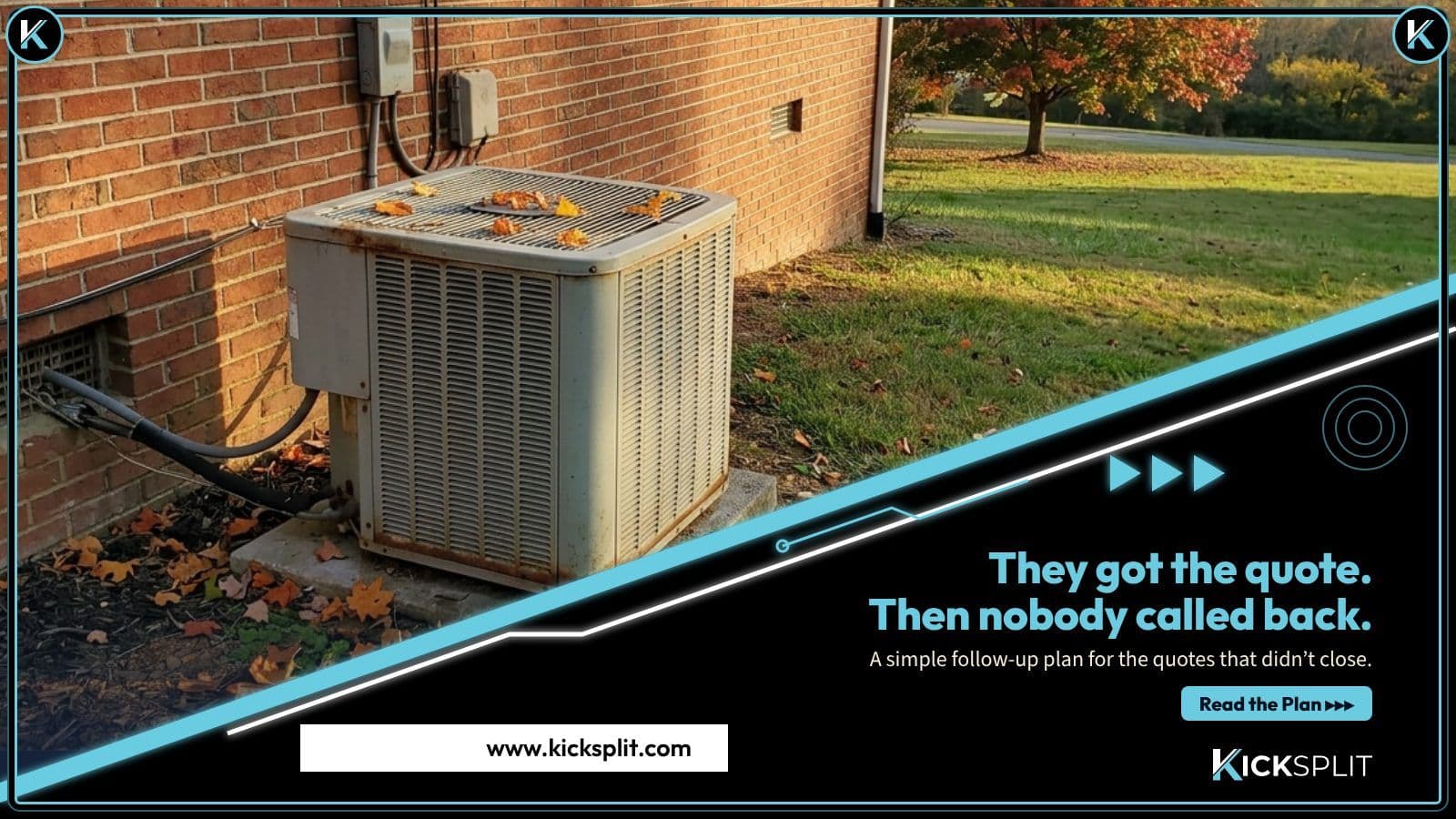
Say your comfort advisor spent an hour and a half at a house in Farragut one Tuesday in April. Checked the attic, looked at the ductwork, sat at the kitchen table and wrote up a $9,000 system replacement. The homeowners said they wanted to talk it over. Everybody shook hands. Nobody from your company has called them since, because there's no unsold estimate follow-up in place, just good intentions.
That quote is sitting in a folder, a CRM or the door pocket of a truck, and it's one of the most expensive leads you have. You paid for the ad that made the phone ring, the truck that drove out, and two hours of someone who could have been running another call. Calling it back is about the cheapest marketing a home-service company can do, and most companies barely do it.
The timing matters right now. The National Weather Service forecast, as reported by Hoodline this week, has the first frost of the season possible in East Tennessee this weekend. Cold nights are when last spring's "we'll think about it" turns into "we need this now," and the homeowner calls whoever is on their mind. The plan below works the same in Knoxville or anywhere else that gets a cold snap, and for plumbing, roofing and electrical quotes as much as HVAC.
Why most unsold estimates aren't a no
People rarely say no at the kitchen table. They say "let us think about it," which can mean a lot of things:
- They're collecting two more bids and yours was the first.
- One spouse wasn't home, and nobody spends $9,000 without the other one weighing in.
- The number was higher than they expected and they're hoping it gets better.
- They need financing and didn't want to ask.
- The old system still runs, so it doesn't feel urgent yet.
- They forgot. Life happened.
Only a couple of those are a real no. The rest are "not yet" waiting on one more conversation. When nobody calls, the homeowner fills the silence with the company that did.
Put every unsold estimate on one list
You can't follow up on quotes you can't see. Start with one list of every open estimate from the last 90 days, with these columns: customer name and phone, date of the estimate, amount, who wrote it, where the lead came from, and why it didn't close, if anybody knows.
A spreadsheet is fine. If your field software tracks estimates, export them from there. What matters is that it's one list, not five advisors' memories and a stack of carbon copies on the dispatch desk.
Then give the list an owner, by name. It can be the person who wrote each estimate, or someone in the office who's good on the phone. "Everybody follows up on their own" tends to mean nobody does, and the busiest advisor follows up least.
The unsold estimate follow-up schedule
Here's a starting schedule. Adjust it for your trade and your ticket size.
- Within two days: a call from the person who wrote the estimate. Keep it short. "Wanted to see if any questions came up after I left."
- About a week out: a second call. If nobody answers, leave a voicemail and send a text right behind it with your name, the company and what it's about.
- When the season turns: a check-in tied to the weather. For HVAC that's the first cold snap or the first hot week. For roofing, after a storm. For plumbing, before the first hard freeze.
- Around 30 days: a close-out call or message. Say you're closing out the quote, say how long the price holds, and tell them to call anytime.
Then stop chasing. Four or five touches over a month is follow-up. A call every other day is how a forgotten quote turns into a blocked number.
One caution on texting: if you plan to automate follow-up texts, have a lawyer look at the consent rules first. Business texting has its own federal and state rules, and this isn't legal advice.
What to say when they pick up
Skip "just checking in." It gives the homeowner nothing to answer except "still thinking." Instead, answer the question they didn't ask at the table.
If it was the price
Offer options. A different system at a lower price, a repair that buys them a season, or financing if you offer it. Plenty of people won't ask about payments in front of a stranger but will say yes when you bring it up.
If a spouse wasn't there
Offer to come back when both can be home, or walk them both through it on the phone. Ten minutes on a speakerphone beats losing the job to whoever got both of them at the table.
If they're comparing bids
Offer to go through the other quotes with them line by line. Don't trash anybody. Point out what to compare: the equipment, the warranty, and what's included, like permits and hauling off the old unit.
If it's timing
Agree with them, then put the next call on the calendar with a date they picked.
No fake deadlines and no "price is only good today." That tactic might close a deal this week and costs you the referral next year.
Give the next quote better odds
Two habits make the follow-up easier.
First, quote options. Good, better, best on every replacement gives the homeowner a choice between your three options instead of a choice between you and the other guy.
Second, write down the reason before you leave the driveway. "Wife wants to see it," "getting two more bids," "waiting on tax refund." Thirty seconds in the truck saves a guessing game on the callback. After a few months, the reasons tell you whether you have a pricing problem or a follow-up problem.
The math on quotes you already paid for
These numbers are made up to show the logic. Say an HVAC company runs 40 replacement estimates a month and closes 16 of them. That leaves 24 open quotes. Say each estimate costs about $250 to get to the kitchen table, counting the ad spend for the lead, the truck and two hours of an advisor's time. That's $6,000 a month spent on quotes that didn't close.
Now say a real follow-up schedule wins back one in eight of those 24. That's 3 more jobs. At $9,000 each, that's $27,000 in sales from leads you'd already paid for, with no new ad spend.
To get those same 3 jobs from new leads at a 40% close rate, you'd need about 8 more estimates, roughly $1,900 more in cost. The follow-up costs a few phone calls.
Your numbers will be different. Track close rate by lead source too, counting jobs that closed on a follow-up call. Then you can judge your marketing on booked jobs instead of lead counts.
What to do this week
- Pull every estimate from the last 90 days that didn't close and put it on one list with the columns above.
- Name the one person who owns the list, and a backup.
- Have them call the 20 biggest quotes before the weekend, ahead of the first cold nights.
- Add a "reason not sold" line to every estimate going forward.
- In 30 days, count how many came back. That number is your case for keeping it going.
If you'd like a second set of eyes on where your leads go after the ad does its job, book a call. We look at the marketing and what happens after the phone rings, because a quote that dies in a folder costs the same as a lead that never came in.